

After the EGU week and towards Nanjing

Read all comments from beginning of discussion


Please read the instructions first

Dear Friends and Colleagues,

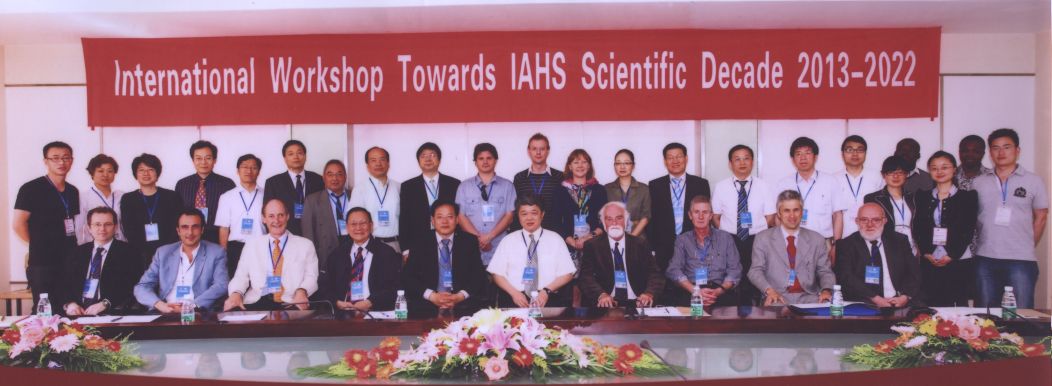
as you know, the agenda for the new IAHS Science Initiative has been, and still is, very busy. From April 22 to 27 the EGU General Assembly took place which hosted very interesting meetings where the new IAHS decade was widely discussed. Finally, from May 11th to 13th the Hohai University in Nanjing (China) is hosting a dedicated meeting of the IAHS Task Force that will also be attended by several IAHS Officers and eminent researchers working in China.
With this post I would like to provide a brief report on the IAHS initiatives that took place during the EGU week, that were very much stimulating.

The first IAHS dedicated initiative was the Task Force Meeting that was opened to IAHS Officers and blog contributors so far. The meeting was attended by 22 persons. It was introduced by the IAHS President Prof. Gordon Young that summarised the process leading to the definition of the new IAHS decade. I gave a short talk (my powerpoint presentation can be downloaded here (32 Mb)) to summarise the blog inouts so far. A long discussion followed with contributions by most of the people who attended the meeting. The minutes can be downloaded here. In my opinion it was a very useful debate. Basically many of us agreed that hydrological change and interaction with society should be the relevant keywords for the new decade. The meeting was closed by Gordon Young who proposed to extend the set of relevant keywords by including: change, uncertainty, vulnerability and risk.

The second relevant appointment for IAHS was the visionary session of the Hydrological Sciences Division that took place on Wednesday, April 25, entitled “Visionary session on the next Hydrological Decade”. The symposia was explicitly dedicated to IAHS and was attended by about 600 people. The very high attendance is a clear proof of the interest of our community in the IAHS activities. Six invited 25-minute presentations were given by K. Beven, G. Young, T. Wagener, H.H.G. Savenije, X. Sanchez-Vila and P. Grathwohl. They all kindly agreed to make their presentations available, which can be downloaded here below.

K. Beven: Can we test model hypotheses of flow and transport in assessing the hydrological impacts of change? (3.6 Mb)
G. Young: Water challenges of the future; how scientific understanding can help (50 Mb)
T. Wagener: Taking the long view of hydrology (16 Mb)
H. Savenije: What are the main research challenges in hydrology? (36 Mb)
X. Sanchez-Vila: EGUvisionarysanchez.pdf (4 Mb)
P. Grathwohl: Diffuse pollution of soil and water: Long term trends at large scales? (15 Mb)

Each talk was followed by stimulating questions that helped gaining a better perception of what the broad community of hydrologists thinks about the most relevant research challenges for the next 10 years.

Finally, on Friday I gave a talk on the new IAHS decade to promote participation to the blog. My talk is available here
.

I am not providing any personal scientific summary of the stimulating discussions I had at EGU because I am planning to write a scientific blog post after the meeting in Nanjing, to summarise the whole discussion so far. Meanwhile, please provide any comment you may have on the IAHS initiatives that took place during the EGU week and the new IAHS decade in general. Please note that the blog discussion on the new IAHS Science Initiative will remain open for the whole summer, but it is extremely important for us to get your relevant comments as soon as possible. Please do contribute with your personal feelings and scientific inputs!

All the very best,
Alberto

Posted in IAHS blog | Leave a comment

The new Science Initiative – First summary of the discussion

Read all comments from beginning of discussion


Please read the instructions first

Seventy days passed since the blog was open and I am glad to see that the first post received some 3000 visits and 20 comments, and the site received 22 user registrations. This is a clear indication that the discussion on the next IAHS scientific decade is relevant for the international community of hydrologists. I would like to draw a first summary of the discussion and to put forward more advanced ideas for setting up the basis of the next IAHS initiative.

Basically, the discussion so far has highlighted that:

  • The new Science Initiative should be a substantial contribution to IAHS community building, should be inclusive (Hilary McMillan) and the subject should be attractive for funding agencies (Bettina Schaefli). It should be a multidisciplinary effort (Fabrizio Fenicia, Stan Schymanski).

  • Hydrological change and variability, and the interaction between hydrology and society, are topical issues that deserve to be focused on (myself, Hoshin Gupta, Stan Schymanski, Giuliano Di Baldassarre).

  • Uncertainty should be a keyword for the new initiative, in an innovative manner with respect to the traditional paradigm that attempted to eliminate uncertainty in hydrology (Demetris Koutsoyiannis, Christian Stamm).

  • Understanding past and present is a key issue to foresee what the future will be (Ciaran Harman). Comparative hydrology is an effective tool to this end (Ciaran Harman, Siva Sivapalan).

  • Modern technologies offer unprecedented opportunities (Salvatore Grimaldi, Demetris Koutsoyiannis, David Post).

  • The new initiative should effectively focus on unstudied areas of the world (Alberto Viglione et al.).
  • The new initiative should provide a sound scientific basis for adaptive management of water resources under uncertainty (Christian Stamm).

I believe the above summary provides a very useful and detailed first picture of the expectation from the IAHS community. I would propose to postpone the discussion related to the name of the new Science Initiative. Ideas for name and acronym will be collected later on. With this post, I would like to discuss the main theme for the new Science Initiative that emerged from the blog comments so far, by also stimulating ourselves to gain a better insight into the above bullet points.

Indeed, hydrological change is recognised to be a topical issue for hydrologists. Understanding and modelling the behaviour of hydrological (uncertain) systems under changing conditions is a compelling necessity to cope with environmental and social evolution and to provide a satisfactory reply to applied engineering problems. I think there is no doubt that the above issue is involving and attracting a wide part of the IAHS community.

However, it is still unclear how change can be modelled besides the traditional “top down” scenario approach. This latter is carried out by identifying and calibrating hydrological models in current conditions and then running them with perturbed parameters or input data according to assumptions on changing forcing and/or dynamics. As a matter of fact, the top down approach has been used in several studies already. On the one hand, it provided useful results. On the other hand, it has proved to be affected by significant limitations due to limited credibility of current models under changing conditions, uncertainty in future scenarios and model parameters. The results so far obtained call for improved approaches to better understand the interaction between hydrological systems and changing socio-economic and environmental forcing, besides what perturbations in input data and parameters suggest.

The question, then, is: what would be an innovative blueprint to understanding and modelling of changing systems? Replying to the above question means to put the basis for a vision on the science plan we are looking for. I am putting some ideas forward, by taking inspiration from what colleagues wrote on the blog. I am looking forward to your follow up.

1) A necessary prerequisite to understand changing system is to improve our understanding of their dynamics, and their evolution, in the current and past situation. The keyword would be “historical hydrology” and “process hydrology”. This is a first milestone that is rooted in classical hydrology and allows us to set up a connection with the previous decades, and in particular PUB, whose success is unquestionable. Experimental activity is essential, as well as improved process-based and stochastic modelling (possibly integrated in an innovative framework). I think a key step is to better understand hydrologic variability and evolution, which is of course extremely important in the face of change. New ideas are needed to effectively integrate experimental and modelling activity therefore gaining new insights into hydrological modelling.

2) A second prerequisite, which is not disjointed by the first, is uncertainty and predictability. Uncertainty should not be viewed as just a mean to compensate limited understanding. In the innovative view we would like to promote uncertainty should be treated as an effect of indeterminacy. It is a behaviour of hydrological processes, due to the fact that in some instances processes evolve randomly. Evolution itself, in biology, includes random processes (see http://en.wikipedia.org/wiki/Evolution), meaning that Nature evolves accordingly to deterministic rules which are integrated with random outcomes.

Predictability is directly related with uncertainty. In fact, randomness implies lack of predictability in deterministic terms. However, statistical prediction of uncertain events is still possible and useful. An interesting reading is provided by http://en.wikipedia.org/wiki/Randomness.

What is important, in my view, is to reduce (epistemic) uncertainty as much as possible while recognising the intrinsic behaviour of random processes in hydorlogy, for which uncertainty will never be eliminated. The ideal framework is the integration of stochastic and deterministic representations, therefore allowing to maximise predictability in both deterministic and statistical terms.

Predictability and uncertainty are extremely important issues in engineering and management. The recent hydrological literature presented several meaningful contributions to uncertainty assessment and modelling. On the other hand, the literature related to PUB is an excellent example of the effort to seek predictability. I think we need to move additional steps forward to set up a unified theory for uncertainty assessment and to fully integrate uncertainty modelling and hydrological modelling.

3) A theoretical scheme needs to be introduced to infer the behaviours of changing hydrological systems in time, in the presence of non-stationarity. Effective tools within this respect are “data analysis”, “comparative hydrology” and “trading space for time”. We also need improved schemes to better take advantage of modern monitoring technologies, by exploiting remotely sensed information on soil moisture, topography, land cover, biology, river network morphology and many others. Indeed, orthogonal information can represent a key for conditioning the dynamics of changing systems.

The question is: what would be the basic principles of such theoretical scheme, besides physical conservation laws and Newton laws? In fact, physical constraints are a necessary but not sufficient condition to model hydrological systems that are changing in time with many degrees of freedom. We need more organising principles to understand how watersheds and hydrological variables will evolve in the future. Ciaran Harman and Alberto Viglione mentioned the issue of “evolution” of “landscape”, “climates” and “coupled human-water systems”. This is the topic we are interested in and I like the term evolution, which implies the presence of constraints in the process. Such constraints are one of our major focuses. Ideas on their identification and formalisation in the hydrological context are more than welcome.

4) Focused activity is needed on modern technologies, to make them effectively useful. There are domains within hydrology (like flood modelling) where modern information indeed helped a lot to improve process understanding and modelling. There are other fields where progresses are obtained with a slower pace. I think there is the need to identify effective data sources for making the above emerging theoretical scheme and constraints applicable. The development of new theory should be carried out by always keeping an eye on practical applications (hydrology is a science with many implications in engineering) and data collection is of course essential to this end. Ideas are needed to identify emerging monitoring techniques that are useful for our purposes.

5) In conclusion, the theoretical scheme needs to be very general, in order to be inclusive and attractive. And, most important, should lend itself to addressing the emerging and unpostponable questions related to the interaction between hydrology and society, which also implies the effective possibility to put adaptation into practice. Indeed, socio-hydrology is emerging from the relevant role that humans are playing on the hydrological cycle and ranks high in the research interests of many countries. It is the result of the human pressures that are rapidly changing in time all over the world. Ideas are needed to assess current pressures, and to predict the future conditions in the face of sustainable development and adaptation. We need a focused brainstorming activity to emphasise the leading role that hydrology must take in environmental planning and management.

I am looking forward to a new round of comments on the above thoughts. We now need focused ideas for drafting an inclusive and coordinated science plan. I would like to remind all of you that the Task Force will meet in Vienna during EGU 2012, where a special session on the new IAHS decade (invited speakers only) is planned within the programme of the Hydrological Sciences Division. Please see http://meetingorganizer.copernicus.org/EGU2012/session/10165.

Please contact me if you are interested to attend the Task Force meeting that will be held during the EGU week.

All the best,
Alberto

Posted in IAHS blog | 18 Comments

Discussion – The new Science Initiative of IAHS


Please read the instructions first

The discussion hosted on this web page is dedicated to the new Science Initiative of the International Association of Hydrological Sciences (IAHS), to be launched in 2013. The aim of the discussion is to identify key scientific challenges for hydrology in the near future, therefore shaping the main focus of IAHS in the next years. Background on IAHS and how the initiative came about is given in the page “About the IAHS new Science Initiative” whose link is provided in the above menu.

Devising a scientific initiative in hydrology is an exciting and stimulating task. Such an ambitious target calls for a community brainstorming activity. In fact, a science initiative is indeed a community effort: ideas must reflect the feeling of as many scientists as possible. Although communication means are very efficient today, to launch a public discussion on scientific questions for the future and to draw a synthesis of its output is indeed a challenging aim.

When I was invited by IAHS to devise and moderate this discussion I felt very much honored. I think this is an extremely interesting experience that I accepted enthusiastically, but I immediately realized that I really need the help of the whole IAHS to carry out the task well. For this reason, after consulting with numerous colleagues and the IAHS Bureau, I decided to open this blog, which I hope will be able to reach out extensively to all IAHS members.

The question that I would like all readers to address is:

“What is your view on the most exciting research challenges for hydrologists in the next 10 years? What are the core questions hydrologists should address that will get a worldwide attention from the community?”

I sincerely hope that this public discussion, which will last for about 6 months, can effectively catch the attention of the IAHS community. I would like everybody, and in particular young scientists, to freely share their thoughts without being shy or concerned about whether their opinions fit in. Any suggestion could be the opportunity for all of us to get in touch with colleagues who could provide a substantial contribution during the subsequent development of the initiative. Summarizing the results of the discussion and writing a draft science plan is a daunting task for which we clearly need a diversity of views.

If you are still in doubt whether or not you should leave a comment on this blog, please contact me.

I am honored to have the opportunity to trigger the discussion by providing my view on the above key question. I’ll be very brief for now, because I want to leave the discussion fully open. Other TF members will provide their thoughts in the near future.

I do have some personal observations. I think one of the most exciting challenges for hydrologists in the future is to better understand how hydrological systems and processes react to changing conditions and forcings, in relation to societal development. In fact, water is facing rising pressures due to increased demands from a growing human population and changing lifestyles, and decrease of freshwater resources due to over-exploitation, land use and land cover changes, and resulting environmental pollution. This is the consequence of efforts to improve the quality of life and therefore it is a positive development. However, the sustainability of this development is questionable.

In fact, in many parts of the world the poor distribution of freshwater in relation to demand is already the cause of water scarcity, which may be exacerbated by climate change (Kundzewicz 2007; Koutsoyiannis et al., 2009; Blöschl and Montanari 2010; Wagener et al., 2010). Moreover, the effect of human activities on the water cycle is deepening and widening rapidly across the planet, driven by increased demands for energy (King and Webber 2008; Koutsoyiannis et al., 2009), water (Jackson et al. 2001), food (Vörösmarty et al., 2000) and living space (Zhao et al., 2001).

Therefore, relevant scientific questions arise about the sustainability of the above changes for hydrological systems and the related effects on society. To improve the societal management of natural resources implies gaining an improved understanding of hydrology. This is an evergreen of hydrology research but –alas – so much remains to be done. In particular, we need to gain a better insight into how water systems react to (rapid) change, by analyzing the two-way connection between society and these water systems (Sivapalan et al. in press, HP). In the non-linear, dynamic interplay of people and water systems complex and very surprising patterns may arise and these we need to understand for being prepared for the future water challenges.

In particular, to distinguish between human induced changes and hydrological variability seems to be a key issue to better understand the interaction with society and how changes will evolve in the future. Identification of change requires a better understanding of variability as a function of space and time scales.

What are the reasons for variability and how does variability scale across time and space? What are the footprints that may allow one to recognize change in (rapidly) varying signals? What are the reactions of systems to change and variability? What about the predicting capabilities? These are deep science questions and at the same time relevant for water management.

The above thoughts make me think that “change”, “variability” and “society” are likely keywords for hydrology in the near future. I believe that meaningful answers to the above questions require a deep understanding of the interactions of hydrological systems and humans in an interdisciplinary framework.

As I said, I would like not to go into details at the present stage. I am looking forward to numerous spontaneous feedback from all of you to better shape the above thoughts! Disagreement is particularly welcome.

Thank you for your interest.
All the best,
Alberto

References
Blöschl, G., Montanari, A., Climate change impacts-throwing the dice? (vol 25, pg 374, 2010), Hydrological Processes, 24, 1094-1094, 2010.
Jackson, R. B., S. R. Carpenter, et al., Water in a changing world, Ecological Applications 11, 1027–1045, 2001.
King, C., Webber, M., The Water Intensity of the Plugged-In Automotive Economy, Environmental Science and Technology, 42, 4305–4311, 2008.
Koutsoyiannis, D., C. Makropoulos, et al., HESS Opinions: Climate, hydrology, energy, water: recognizing uncertainty and seeking sustainability, Hydrology and Earth System Sciences, 13, 247–257, 2009.
Koutsoyiannis, D., Montanari, A., Lins, H.F., Cohn, T.A., Climate, hydrology and freshwater: towards an interactive incorporation of hydrological experience into climate research, Hydrological Sciences Journal, 54, 394–405, 2009.
Kundzewicz, Z. W., Mathematical modelling of ecohydrological systems in the changing world. Wetlands: Monitoring, Modelling and Management. T. Okruszko, E. Maltby, J. Szatylowicz, D. Swiatek and W. Kotowski, 151-159, 2000.
Sivapalan, M., Savenije, H.H.G., Blösch G., Socio-hydrology: A new science of people and water, in press on HPToday, 2011.
Vörösmarty, C. J., P. Green, et al., Global water resources: Vulnerability from climate change and population growth, Science 289(5477), 284–288, 2000.
Wagener, T., Sivapalan, M., Troch, P.A., McGlynn, B.L., Harman, C.J., Gupta, H.V., Kumar, P., Rao, P.S.C., Basu, N.B. and Wilson, J.S. 2010. The future of hydrology: An evolving science for a changing world. Water Resources Research, 46, W05301, doi:10.1029/2009WR008906.
Zhao, M., Pitman, A. J., Chase, T. N., The impact of land cover on the atmospheric circulation, Climate Dynamics, 17, 467–477, 2001.

Posted in IAHS blog | 22 Comments